
Southfield, MI · Garage Door Service
Panel Replacement for Oak Park's 1958-Era Garage Doors
Oak Park homes date to 1958, built before insulated steel panels were standard. We match panel profiles from Southfield, four miles away, not generic sizes.
- Repairs & new doors
- Springs & openers
- Serving 8 nearby communities
Time on the Job
Most of the garage doors we replace panels on in Oak Park came with the house, and the house usually went up around 1958. That's not a guess - it's the median build year for this part of the service area, and it puts Oak Park squarely in the older half of what we work on, not the newer end where the stock runs through the 1980s. Across the service area's roughly 214,132 owner-occupied houses, this 1958 vintage is common, not rare, and that's a bit below the service area's median household income of $70,185, which doesn't change the panel, but it does shape whether a homeowner opts for a single-panel repair over replacing the whole door. A door hung in 1958 is a different animal from one hung in 1985: different panel height, often a different section count, and track hardware nobody sells new anymore. The time spent on a panel swap here goes less into the physical install and more into tracking down a panel that actually fits the section above and below it. The truck runs out of Southfield, four miles from Oak Park, loaded with what we think the job needs based on the call - but on an original 1958 door, the first trip can turn into a measuring trip before it's a repair trip.
What Causes It Around Here
Cold does more damage to a garage door panel than people expect, and this area sits in a climate band classified as cold and severe. The freeze-thaw cycle works on the bottom panel first - moisture gets into a seam or a ding, freezes, expands the gap, and by the next thaw the steel has flexed enough to crack the paint seal. Once that seal is gone, rust sets in from the inside out, so a panel can look fine from the driveway and still be perforated along the bottom lip. The other driver is just age: a house built in 1958 has put that door, or a replacement from decades back, through roughly seventy winters of exactly that cycle. Road salt tracked in off the driveway speeds up bottom-panel rust specifically, since that's the panel closest to the slab and the one that holds standing moisture longest. We don't see this as often on upper panels unless there's been a direct hit - a backed-into door, a basketball, a ladder leaned wrong. Lower-panel rust-through is the call we get most out here, and it's almost always the oldest house on the block, not the newest.
The Symptom
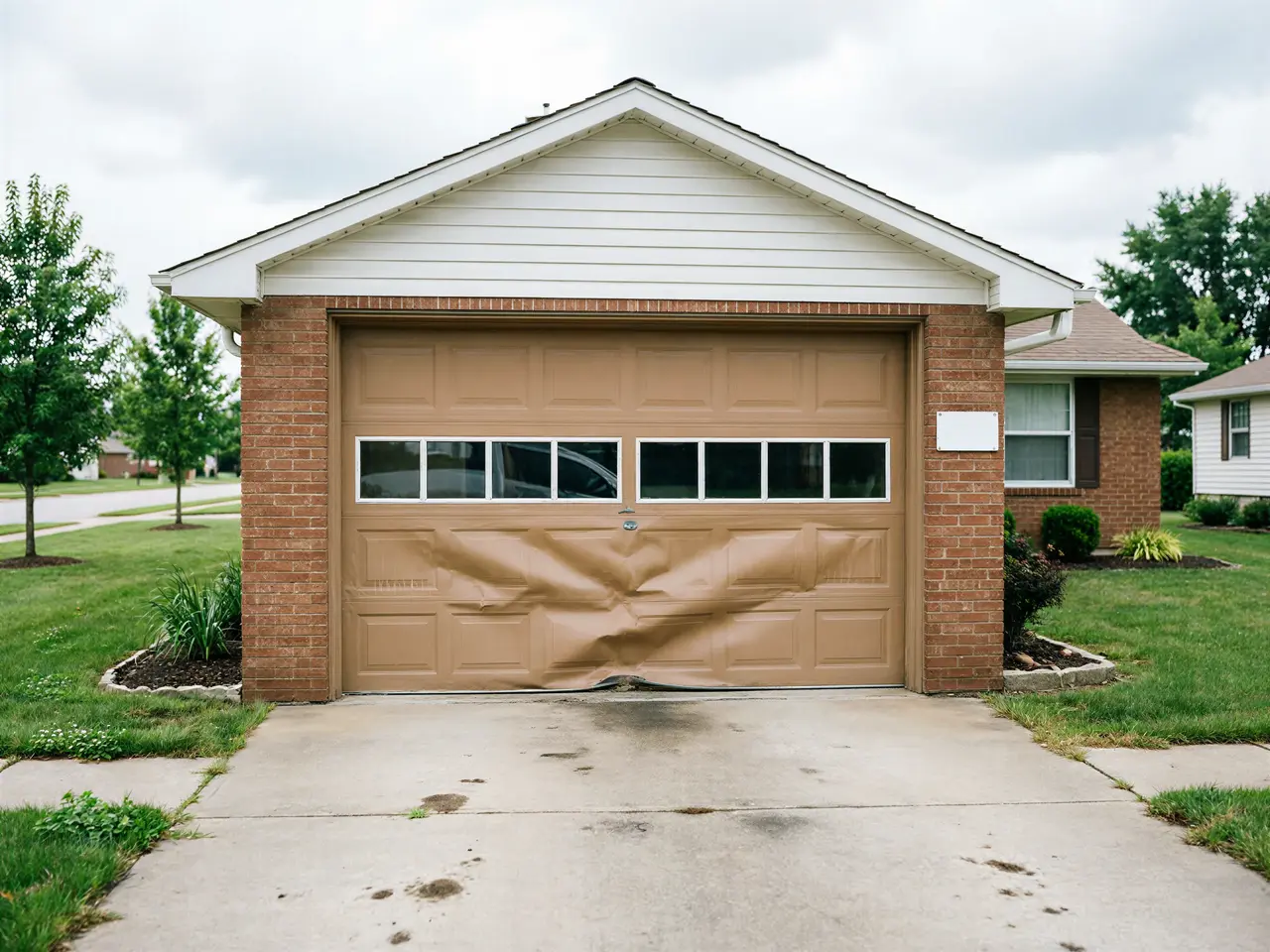
The complaint is usually one of three things: a panel visibly bowed inward near the bottom, a seam rusted through enough to show daylight, or a section that no longer sits flush against its neighbors when the door is down. Sometimes it's cosmetic only - a dent from a mirror or a cart that hasn't compromised the steel - and in that case a panel swap is overkill; we'll say so. The symptom that actually means replacement, not just a ding, is when the panel has lost shape enough that rollers bind in the track or the bottom seal won't compress evenly across the width of the door. On the 1958-era doors specifically, we also see panels that have simply thinned - decades of paint and repaint over steel that was never galvanized to today's standard, so the metal has lost thickness along the stress points, mainly the hinge screw holes. Stripped hinge holes are a telltale sign the panel, not just the dent, needs to go. None of this shows up overnight; it's usually a slow accumulation a homeowner only notices once the door starts dragging or catching partway down.
Where This Job Goes Sideways
A panel swap on a 1958 door assumes you can get a panel that matches the others. That's the part that goes wrong. Steel gauge, panel height, and window-cutout patterns all shifted over the decades, and a door built in that era can have a profile nobody manufactures now in that exact run. When we can't source a true match, the honest options are: run a close match and accept a visible seam between old and new steel, or replace the whole door. We won't pretend a mismatched panel looks fine - it doesn't, and we'll say so before ordering anything. The other way this goes sideways is hardware: original 1958 track and hinges were sized for the original panel weight, and even a close replacement panel can throw off that balance enough to stress the opener or the spring. At that point the repair has turned into more than a panel, and on an older door that's worth knowing before the job starts, not after. We don't carry every discontinued profile, and we won't claim we do. Sometimes the right answer, once you add up the labor and the mismatch, is a new door rather than a patched one.
What Is on the Truck
We stock panel sections that cover the steel sectional doors built from the late 1930s through about 1990, which describes most of what's standing in Oak Park and the towns around it. That means a handful of standard heights and a few common window-cutout patterns, enough to match a large share of calls without a special order. What we don't carry is every discontinued profile from a specific decade - on a true 1958 original, we may need to order the panel rather than install it same-visit, and we'll tell you that up front rather than promise a match we don't have. We also carry the fasteners, hinges, and roller stems that pair with older panel gauges, since a new panel on old hardware is its own small mismatch if the hinge screws don't bite the same way. The truck runs out of Southfield, four miles from Oak Park, and what's loaded on it reflects what gets called in most from houses this age, not a generic parts list. For the full rundown of what we handle here, see our Oak Park garage door service page; for the panel job written up for Southfield itself, that's a separate page.
Frequently asked questions
Can you match the panel on my 1958 garage door exactly?
Sometimes. We stock common heights and window-cutout patterns that cover doors built from the late 1930s through about 1990, which fits a lot of Oak Park. But a true original 1958 profile can be discontinued, and in that case we'll need to order it rather than install it the same visit. We'll tell you that before we schedule, not after we show up.
How do I know if I need one panel or a whole new door?
If the damage is cosmetic - a dent that hasn't bent the steel or cracked a seam - a panel swap usually handles it. If rollers are binding in the track, hinge holes have stripped, or we can't source a matching panel for your door's original profile, replacing the whole door can end up cheaper and better-looking than patching one section.
Why does the bottom panel rust before the others?
It sits closest to the slab and holds moisture and road salt longest. Combined with this area's cold winters, that panel goes through more freeze-thaw cycling than the ones above it, which cracks the paint seal and lets rust work in from the inside before it ever shows on the surface.
Do you keep a crew based in Oak Park?
No. We run out of Southfield, about four miles away, and bring what the call needs based on your door's age and symptoms. We don't have a local depot in Oak Park, so the first visit may double as a measuring trip on older, harder-to-match doors.
Book garage door service in Southfield
Call now or request a quote - tell us what the door is doing and where you are.