
Southfield, MI · Garage Door Service
Garage Doors on Southfield's Pre-1960 Housing Stock
Southfield's housing stock mostly predates 1960, built before insulation rules existed for garage doors. Here's what that means for repair and replacement in this climate.
- Repairs & new doors
- Springs & openers
- Serving 8 nearby communities
The Cost of This Job
Most of the garage doors we open up in Southfield were hung on houses built between 1938 and 1990, with the median falling around 1958. That matters more than people think. A door installed on a house from that era was built to a standard that had no insulation requirement at all - it's a single layer of steel or wood, no foam core, no thermal break. When a homeowner calls wanting that door swapped for a modern insulated one, the labor isn't just pulling panels. The track hardware, the header clearance, and sometimes the framing itself were sized for a door built to a 1950s-1960s spec, and a new insulated door is thicker and heavier. That can mean adjusting the jamb or the header before the new door even goes in, which adds time to the job that a newer subdivision wouldn't need. We don't post a flat number here because the opening itself decides a lot of it - a straightforward panel swap on original hardware costs less than a job where we're rebuilding a track system that's been patched twice already. What we can tell you up front: if your house falls in that pre-1960 bracket common across this area, budget for the hardware conversation, not just the door.
What the Weather Here Does to It
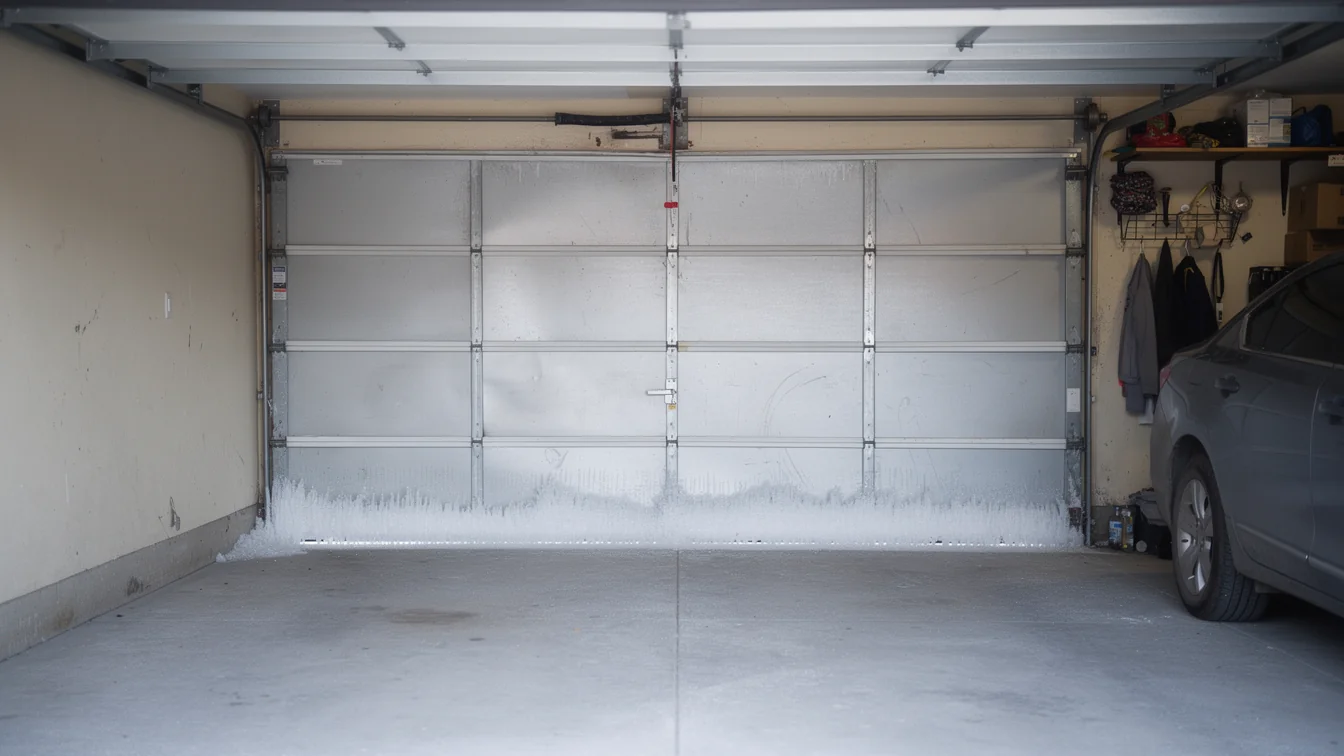
This area sits in a severe cold climate band, and an uninsulated steel door from the pre-insulation era handles that badly. Without a foam core, the panel itself becomes the only barrier between your garage and the outside air - it contracts in deep cold, which is why original doors from this housing stock often develop a bow or a gap at the bottom seal that wasn't there in October. Condensation is the other half of it. Warm garage air hitting a cold single-layer panel beads up on the inside face, and over a winter that moisture works into the bottom panel seam and the roller brackets, which is where we find rust on doors that otherwise look fine. None of this is a defect in the door - it did what a 1950s or 1960s door was built to do. It just wasn't built for the thermal swings this climate puts on it decade after decade. A door with a foam core doesn't flex the same way, and that's the real difference between an insulated replacement and a repair on the original panel.
The Situation
Southfield's housing stock skews old - most of the lots here, and across the 51 named areas nearby, were built in that 1938-to-1990 window with a median year of 1958. That's decades before any building code required insulation in a garage door, and it shows in the hardware we find on service calls: side-mounted torsion springs, single-layer panels, and openers bolted onto brackets that were never rated for the heavier doors sold today. With roughly 214,132 owner-occupied houses across the broader service area, a large share of them are sitting on garage doors that predate the insulation standard entirely. That's not a problem on its own - a well-maintained 1958 door can still run smoothly. But it means every job here starts with figuring out what era the door and the opening belong to, because the fix for a 1958 door and the fix for a 1995 door are rarely the same parts, let alone the same approach.
What Most People Get Wrong
The most common mistake we see is someone replacing the opener and expecting the cold-weather sluggishness to go away. It doesn't, because the opener was never the problem - a single-layer steel panel from before insulation rules existed is still a single-layer steel panel after the new opener goes in. The second mistake is assuming a bowed panel is a sign the door needs full replacement. Sometimes it is. But on original 1950s and 1960s doors, a bowed bottom panel is often just the steel responding to repeated freeze-thaw cycles, and a strut kit or a panel swap solves it without touching the rest of the door. One honest limitation here: if the opening has settled out of square over sixty-plus years, which happens on some of this older housing stock, we may need to square the frame before any new door - insulated or not - will seat right. That's a separate trip, not something we fold into a same-day install.
Frequently asked questions
Why is my garage door so much colder than the rest of the house in winter
If your house falls in Southfield's common 1938-to-1990 build range, your original door was likely installed before insulation standards for garage doors existed. It's a single layer of steel or wood with no foam core, so it transfers outside cold straight through. An insulated replacement panel changes that; the opener does not.
Is it worth replacing an original door from the 1950s or 1960s
Depends on condition, not age alone. If the panels are straight and the hardware is sound, a strut kit or seal replacement can carry it a few more winters. If the bottom panel is bowed or the track hardware is rusted from decades of condensation, replacement usually costs less over time than repeated repair calls.
Will a new insulated door fit my old opening
Often, but not always. Openings built to a 1950s or 1960s spec can be narrower or have less header clearance than today's standard doors need. We check the opening before quoting, because on some of this older housing stock the frame needs adjustment first.
Related garage door services in Southfield
More garage door guides
Book garage door service in Southfield
Call now or request a quote - tell us what the door is doing and where you are.