
Southfield, MI · Garage Door Service
When a Spring Goes in Cold Weather in Southfield
Southfield homes built 1938-1990 run original hardware into a severe cold climate. Here's what breaks, what it costs to fix, and what homeowners get wrong.
- Repairs & new doors
- Springs & openers
- Serving 8 nearby communities
The Cost of This Job
A broken torsion spring on a standard double door is a different job than a broken spring on a single door with a heavier insulated panel, and Southfield has a lot of both, depending on which decade the house went up in. Homes from the 1938-1990 range (median build year 1958) often carry original one-piece doors or early sectional doors on torsion hardware that nobody manufactures anymore, which means the spring itself might be a stock size or might need to be special-ordered. That difference changes the bill more than anything else.
We won't quote a number here because we don't know which door is on your garage until we see it. What we will say is this: if the spring broke because it's original to a house built before 1960, the labor is usually straightforward but the part search sometimes isn't. If the spring is newer and just wore out, that's a same-day stock job. Ask whoever you call to tell you which situation you're in before they start work, not after.
What the Weather Here Does to It
Southfield sits in a climate zone classified as severe cold, and that matters more for garage door springs than most homeowners realize. Steel contracts when it's cold, and a torsion spring that's already fatigued from years of cycling is more likely to snap on a sub-freezing morning than on a mild one in October. The spring doesn't know the difference between winter and summer until the metal is already stressed, and then it does.
The second thing cold does is make the grease in older bearing plates and center brackets stiffen up, which puts extra load on the spring every time the door opens. On a house with 1950s or 1960s hardware, that stiff grease and a spring that was never upgraded is a bad combination. We see this pattern every year once temperatures drop and stay down for a stretch: the door worked fine in November and fails the first week it's consistently below freezing.
The Situation
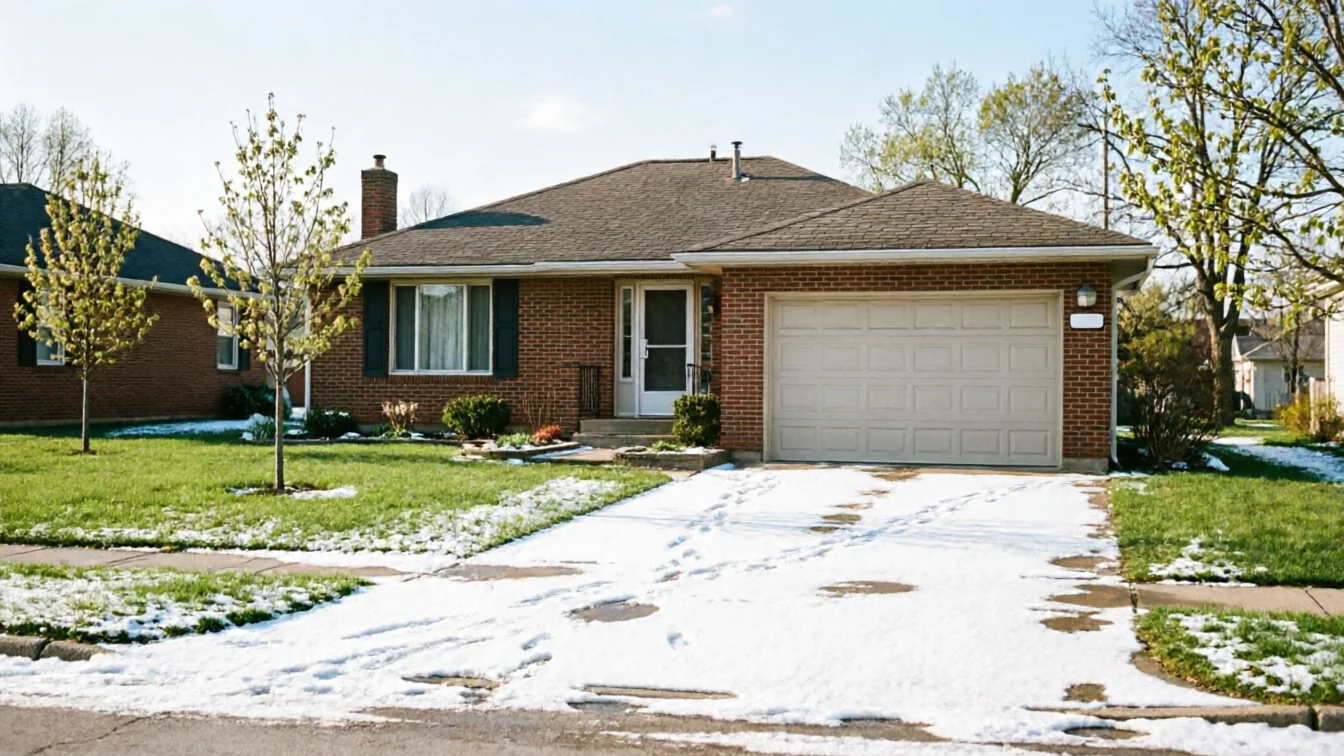
Across the Southfield area, housing stock runs mostly pre-1960, and that's true in most of the named communities nearby too, not just here. A house built in 1958 has had a garage door for close to seventy years, and unless someone replaced the opener and spring system at some point, what's in that garage right now is either original or a straight swap of the original part with the same undersized spring rating.
The area's 393,720 households and 214,132 owner-occupied houses mean this isn't a small or unusual problem. It's the normal condition of the housing stock. A spring that was correctly sized for a lightweight 1958 door is often undersized once someone insulates the panel or adds a heavier opener later, and that mismatch is exactly the kind of thing that shows up as a snapped spring on the first genuinely cold morning of the season.
What Most People Get Wrong
The most common mistake is assuming a broken spring means a broken door. It almost never does. The door itself, especially an older one-piece or early sectional model, is usually fine. The spring is a wear part, like a belt or a bearing, and it's supposed to fail eventually. Replacing it is routine.
The second mistake is trying to open the door manually after a spring breaks, without disconnecting the opener first. Without the spring doing its job, the full weight of the door transfers to whatever pulls it, which is usually the opener's drive mechanism. That's how a $30 spring job turns into an opener replacement too.
The third mistake, and the one we can't fix for you, is waiting. A spring under stress in cold weather doesn't improve on its own, and a door that's hard to lift one week is often a door that won't lift at all the next. We don't carry every spring size on the truck for every house built between 1938 and 1990 - some of the older torsion sizes take a day or two to source. That's the honest limitation here, and it's worth planning around instead of being surprised by it.
Frequently asked questions
Why did my spring break overnight with no warning?
Torsion springs fatigue gradually from thousands of open-close cycles, and cold steel is more brittle than warm steel. A spring that's been weakening for months often holds until a hard freeze pushes it past the point of no return. There's rarely a single dramatic cause - the cold is usually the last straw, not the whole story.
Is my door too old to repair?
Not usually. Most of the pre-1960 doors still in service around Southfield are structurally sound; it's the hardware, not the panel, that wears out. Replacement makes sense when the door is also rusted through, warped, or the track is bent beyond adjustment. A broken spring alone is almost always a repair, not a replacement decision.
Can I replace a torsion spring myself?
We'd tell you not to. Torsion springs are under enough tension to cause serious injury if the winding bar slips, and the sizing has to match your door's weight and the hardware it's mounted on. This is one job where the risk-to-savings ratio doesn't favor doing it yourself.
Related garage door services in Southfield
More garage door guides
Book garage door service in Southfield
Call now or request a quote - tell us what the door is doing and where you are.